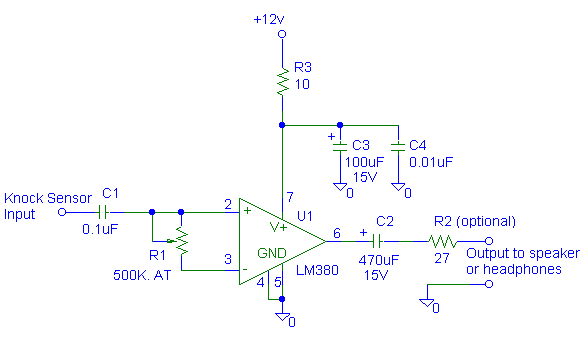
I tapped into the knock sensor wiring, ran the signal through an audio amplifier and into some headphones, so now I can hear what the knock sensor hears. There is more than one way to do this, and I am providing two here.
The easiest way is to use a portable cassette recorder as an amplifier. The other is for those who would rather build a cheap audio amplifier.
The circuits on this page have been tested on my 1992 Eagle Talon. I would expect them to work fine on any vehicle which uses an acoustic knock sensor. Note that the Talon/Eclipse knock sensor is wired directly to the injection computer. Some other vehicles (Buick GN) use an external knock processing unit (knock filter) between the knock sensor and the injection computer. In this case, you will need to tap into the knock signal on the sensor side of the filter.
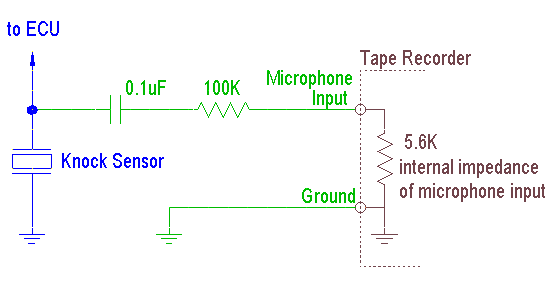
The values here are not critical at all. The 100K ohm resistor (any wattage) is mainly used to prevent loading of the sensor. It will also attenuate the signal by a factor of about 20 on a typical recorder. The actual attenuation will depend on the input impedance of the recorder's mic input. The sensor puts out a lot more signal than a conventional condenser microphone (apparently just because there is a lot more energy going in to it). So it is recommended to attenuate the signal by a factor of 10 or more, the recorder still gets plenty of signal.
The capacitor is there to make the ECU happy. If the capacitor
is omitted, the "check engine" light will come on. Apparently there
is some small bias applied to the sensor, probably just used as a short
circuit test for the ECU diagnostics.
If this is a stereo recorder, I recommend using just one channel for knock, and put a standard microphone on the other channel. You can then use the spare channel for making verbal notes about where you are and what you are doing (very useful for road testing, though maybe not at the track).
R1 is the volume control. When the wiper is all the way down (at pin 3), then the inverting and non-inverting inputs of the amplifier are getting the same signal, so there should be no output. When the wiper is all the way up (at pin 2), the inverting input is getting very little input, and the amplification will be at its maximum.
C2 blocks DC to the speaker (or headphones). R2 is a limiting resistor, to be used with headphones only, to prevent power up spikes from possibly damaging the headphones. This will also significantly reduce the power output of the amplifier. This seems to work well with walkman type headphones, but for a speaker (or any case where you cannot get sufficient volume), this resistor should be omitted.
R3, C3, and C4 form a noise filter for the power supply. The reason
for using a small capacitor like C4, is to kill high frequency noise.
A relatively large capacitor such as C3, often has too much internal inductance
to be effective at high frequencies.
| Written and maintained by Bill Sundahl |
Last modified on December 11, 1999
|