Engine Knock Theory
Engine knock (also called ping) refers to the sound made
when the fuel mixture detonates. (This is NOT the same thing as pre ignition,
though pre ignition can CAUSE detonation.) The terms "knock" and "detonation"
are used interchangeably (even in most technical documentation) to describe
the event of fuel detonation. I will use "ping" to refer the sound produced.
Normally, your fuel mixture is supposed to burn smoothly, from the point
of ignition (the spark plug), to the edge of the cylinder. Imagine a flame
front, which starts at the spark plug and moves out in all directions at
a steady speed, until all fuel has been burned. The piston is moving this
whole time, still moving upward (the last of compression stroke) when the
burn begins, moving past TDC, and moving down again (into the power stroke)
as the burn finally completes. As the mixture burns, cylinder pressures are
increasing dramatically due to several factors:
- Temperature is increasing due to combustion, and we all know that
hot gasses expand. (PV=nRT (note 1) applies very nicely
during the power stroke, since this equation is specifically for closed systems.)
- Liquid gasoline is being converted (via chemical reaction) to various
gases, and a gas is far less dense than a liquid. I'm no chemist, so
don't take the following as gospel. Basically, the hydrocarbon compounds
in the gasoline are combining with oxygen to produce CO and CO2 and H2O.
Other reactions occur also (such as nitrogen and oxygen from the air, combining
due to the heat and pressure to form NOx compounds) but they are side effects,
and are not relevant to increasing pressure (in fact, they may actually
decrease the temperature since some of these reactions absorb energy). (Note
the PV=nRT does NOT apply to chemical reactions or state changes.)
- The spark almost always fires before the piston reaches top dead
center (this is the "timing advance" on my data logs below), so until we
reach TDC, the cylinder pressure is also increasing due to shrinking volume
(PV=nRT again).
The fuel mixture has a flash point; a temperature / pressure point at which,
instead of the steady controlled burn that we want, the remaining mixture
just explodes. This is detonation. The result is, that instead of a steady
pressure increase, we get a nearly instantaneous pressure increase in the
cylinder. This is analogous to hitting the whole inside the combustion chamber
with a hammer. Severe enough detonation can cause physical damage. It is most
often the piston rings and ring lands which suffer, because they are the
weakest pieces in contact with the combustion gasses.
Pre ignition
I will throw this in here just for completeness, though it is not directly
relevant. Pre ignition just means that the fuel mixture ignited before it
was supposed to (before the sparkplug fired). This usually is caused by some
hot spot in the combustion chamber, such as glowing carbon deposits, or an
over heated sparkplug electrode due to incorrect type of plug or a hot running
(lean) cylinder.
The same burning process will occur as described above, but because the
process started early, the process will be farther along as we reach TDC,
our point of minimum volume. This means that the cylinder pressures will be
higher than they would have been, had the burn started at the correct time.
The higher pressure means it is more likely that the mixture will detonate.
Knock Sensor
The knock sensor used in the Talon/Ecllipse/Laser (and many other turbo
cars) is basically just a microphone screwed into the side of the engine
block. You can actually connect an audio amplifier to the output of this
sensor and hear the pinging caused by detonation (along with all the other
rattles, clatters, and bangs that the engine makes). The ping does have a
fairly distinctive sound, that I would describe as similar to the "twang"
that you can get from flexing a piece of sheet metal. The ECU contains a
filter circuit which tries to pick out just the sound of the ping, and ignores
everything else. The consensus on the Talon
Digest is that this circuit is not perfect (lifter clatter for example,
is well known for getting through the filter and being seen as knock), but
overall it does a pretty good job.
This is what engine knock sounds like, directly
from the knock sensor.
Instantaneous Knock
There are three internal variables used by the Talon ECU to represent the
current knock conditions of the engine: instantaneous knock, knock
sum, and octane. The pinging sound itself is a very quick,
lasting less than 1/10th of a second. Instantaneous knock tracks this.
This value is NOT loggable on the TMO datalogger.
Instantaneous knock is responsible for immediately reducing ignition timing
when significant knock is detected.
Knock Sum
Knock sum is a short term value, representing engine knock over the last
few seconds. It is derived from instantaneous knock. Knock sum
will climb very quickly when knock is detected, then will bleed down slowly.
The knock sum will go back to zero when you shift gears (I suspect that this
is triggered by the throttle position dropping below a certain point, thus
if you speed shift, your results will likely be different).
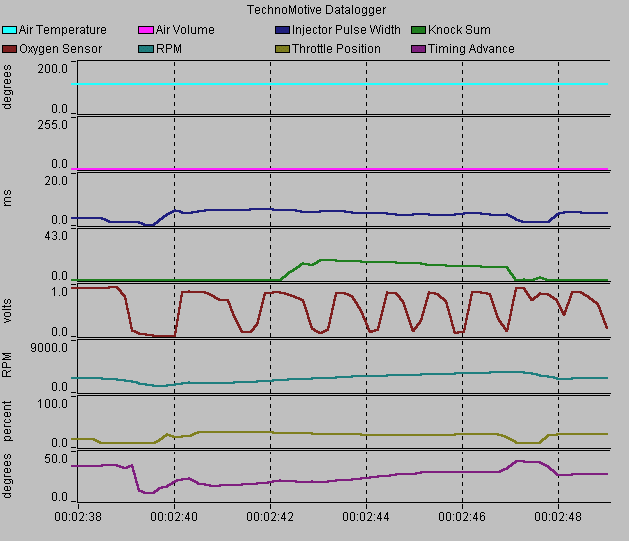
Here is an example of engine knock being detected a few seconds into second
gear (this is very mild acceleration). You can see the knock sum (the
green trace) slowly decrease over the next four seconds, then goes to zero
on the shift to third (seen by the throttle position and RPMs dropping).
Fuel Octane Rating
The octane rating of a gasoline is a measure of its resistance to detonation.
The higher the octane rating, the higher its flash point, thus the more
heat and pressure we can put on the fuel mixture before it detonates.
The knock sum value is used to derive a much longer term value, which
TMO calls octane. This is the knock value over the last 60 miles or
so of driving, and is meant to be representative of the quality of fuel that
you are using. This term is NOT presently loggable.
When the knock sum is 3 or below, the octane value is slowly increased.
Between 3 and 7, nothing is done to octane. Above 7, the octane value
is decreased. The octane value is one of the numbers that the ECU
uses when calculating ignition timing. In fact, (as I understand it)
the knock sum does not directly effect the ignition timing, but rather changes
the octane value, which in turn effects the timing.
Here is how Todd (the TEL ECU master) describes octane and how it effects
the fuel curves:
Here is basically how the whole engine timing control feedback loop
works.
There are two tables in the ECU. Both of them use RPM for one
coordinate, air mass in the other coordinate. One of the tables is
for the minimum timing the ECU will ever put out, the other is the maximum
the ECU will ever put out.
Imagine a 3-D space with the lower map on the bottom and the upper
map on top, overlaid on each other. So we have an X/Y/Z space where
X is RPM, Y is air mass, and Z is what I like to call "octane". When
the ECU needs to calculate timing, it traverses the X and Y coordinates.
Now imaging a "pole" that stands up from the bottom map and extends to the
top map. This pole length will change depending on which part of the
map you are traversing. Now take the "octane" value (0-100%) and multiply
that times the pole length. Then add that to the value at the base of
the pole.
If your "octane" is zero, you get the bottom map. If it is 100%,
you get the top map. If it is 50%, it is somewhere halfway up the pole.
Whenever knock-sum is below 3, the ECU starts climbing the pole (if
it isn't already at the top). It climbs very slowly. However,
whenever the knock sum gets above 7, it slips down very quickly. Since
it can go all the way to 43, it usually slides a little bit farther than it
climbs. Under steady state conditions, the ECU is always trying to
climb that pole. It doesn't intentionally try for knock. In fact,
if you are running, say, 118 octane, the ECU might spend all of its time
on the ceiling. But it can't go any higher, so it still isn't getting
any knock.
It is my suspicion that the top table is for, say 92 octane at 11psi,
and the bottom table is for, say 87 at 7psi. BUT - it seems that people
can still get value out of 110 octane fuel, so that would imply that the top
table might be for a higher octane. Or maybe that is just a function
of topping off the boost to 22psi.
There are other minor terms that affect the above timing, like whether
the car is warmed up or not, but they usually don't affect normal driving.
The biggest impact is if the instantaneous knock term that the ECU uses
to derive knock sum is above a certain amount, it will subtract a raw 4 or
8 degrees off immediately. BTW, this is a knock term you can't read
yet...
How The ECU Controls Knock
The ECU uses three methods to reduce engine knock:
- Retarding timing
The ECU will reduce the timing advance. This is just the opposite of pre
ignition, i.e., the mixture ignites late, rather than early. Because the piston
will be farther along in its stroke at any point in the burn, cylinder pressures
will be reduced. A drop in timing advance is usually very visible on the
logger when significant knock occurs.
- Richen fuel mixture
It is not intuitive, but a richer fuel mixture will burn slower and cooler
than a leaner mixture. Thus the ECU is able to reduce cylinder pressure by
adding additional fuel to the mixture. This can be seen on the logger as an
increase in the oxygen sensor voltage. This should also be visible as an
increase in injector pulse width, however this is usually difficult to see.
- Close boost control solenoid
The ECU will close a boost control solenoid (BCS) which will reduce the
maximum pressure output of the turbo (assuming a stock boost control setup).
Less boost means less fuel mixture going into the engine, which means lower
cylinder pressures. This cannot be easily seen on the logger. The logger
does not monitor the BCS.
This seems like an appropriate place to point out (in case it's not obvious)
that the pressure in the cylinder is exactly where the power comes from
that we get out of the engine. The higher the cylinder pressure, the more
force against the piston, and the more power we get. Since the ECU reduces
knock by reducing cylinder pressure, it also reduces the engine power output.
Boost Control Solenoid
The boost control solenoid is a safety device that the factory engineers
put in to protect the engine under extreme conditions. It does this
by closing the factory air bleeder, thus limiting boost pressure to about
9psi (assuming a stock setup). There are three things that I am aware
of which can cause the BCS to close:
(**This needs verified**)
- Very high air flow
When the ECU detects air flow beyond a certain point, it assumes that something
is wrong, and closes the BCS to try to protect the engine. This condition
is often seen at high RPMs with moderate engine modifications.
- Heavy knocking
Short term engine knock (I don't know which value) can cause the BCS to
close for a few seconds, until the knock goes away.
- Low octane
If the octane value gets bad (low) enough, the ECU will close your boost
control solenoid for an unlimited length of time (until the octane value rises).
The BCS never just flatly turns on or off, but instead pulses, with a varying
pulse width over the course of several seconds, to gently switch from on
to off, or vice versa (the exception is when turning the ignition key on
or off). If an LED is connected to your BCS, the first two cases above
are usually seen as a flickering of the LED. The third case is more
interesting: when the octane drops below the limit, the BCS does NOT close
right away. It will wait until the next time you start the car.
The BCS will then remain closed continuously until the octane value rises
above the limit. The BCS will then open, while you are driving.
Bad Or Disconnected Knock Sensor
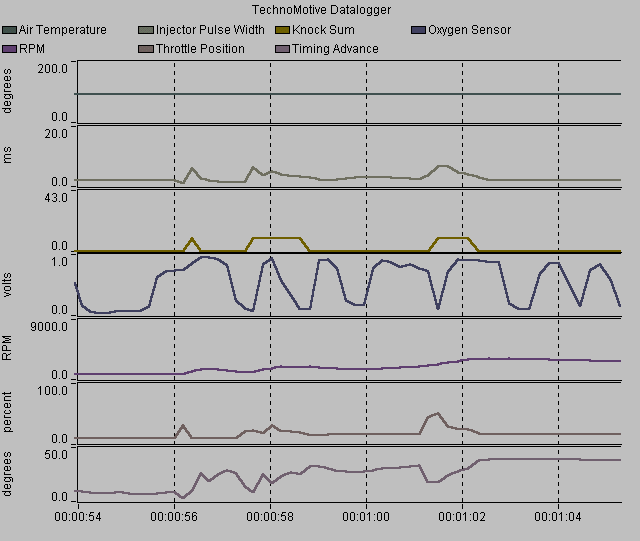
If the knock sensor is not putting out any signal at all, the ECU will
derive its own knock sum internally. The derived knock sum (in 1992
at least) is either 0 or 11. No other values are used. The derived
knock sum seems to be based on acceleration: if the RPMs are increasing significantly,
the knock sum goes to 11, else it goes to zero.
This is an example of a log with the knock sensor disconnected.
Notes
1. PV=nRT ..... Pressure * Volume = quantity(n)
* R * Temperature
This equqation applies to gasses in a closed system (no gas escapes
or enters).
P = pressure. Zero pressure is a vacuum Atmospheric pressure is about
13psi?
V = volume of closed system.
n = quantity of gas in the closed system. This can be thought of as the
number of molecuels of gas.
R = equation constant. This will depend on the units used for all the other
parameters.
T = temperature above absolute zero, usually in degrees kelvin.
| Written and maintained by Bill Sundahl |
Last modified on January 24,2004
|