All of the sounds on this page were recorded from the knock sensor on my 1992 Eagle Talon, using a conventional cassette recorder. The results should be similar on any vehicle using an acoustic knocks sensor.
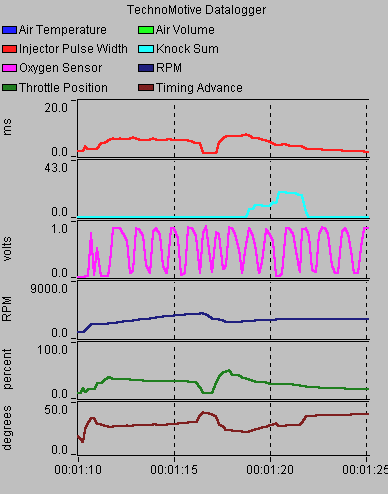
This log show second and third gear. If you play this sound file, which corresponds to this log, you
can hear the same sounds that the ECU hears. The pinging is audible
just after the shift to third. It has a fairly distinctive sound, that
I would describe as similar to the "twang" that you can get from flexing
a piece of sheet metal. You will also notice a rather loud crackle
around the top of second. I hear this a lot, and I am fairly sure that
it is electrical interference, rather than a mechanical sound from the engine.
I can't be certain that the ECU is actually hearing this at all... it could
just be due to how I have my recorder wired. You will notice that it
does NOT show up as knock, even though it is quite loud.
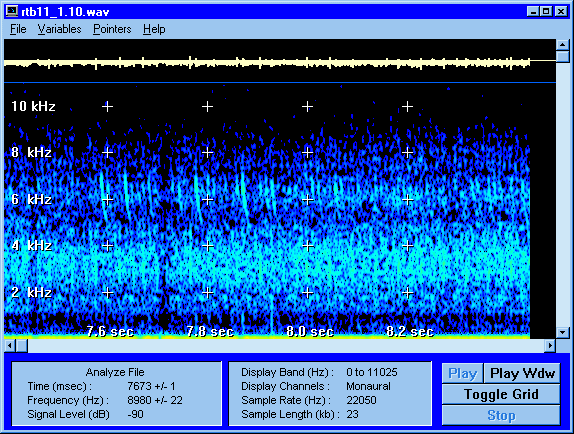
A spectrum analyzer is a tool (may be hardware of software) which shows the frequency content within a sound (or radio wave or whatever). Spectrogram is a freeware spectrum analyzer for the PC. It shows a "3 dimensional" graph, where the X axis is time (same as an audio wave form viewer), the Y axis is frequency (as opposed to signal amplitude in a wave form viewer). The "3rd" dimension is color, and is used to show amplitude or intensity. A dark color (black or dark blue) indicates little or no content at that particular frequency and point in time. A light color (mostly light blue in my images) indicates a stronger content.
The spectrum shown here covers about one second of time, corresponding to roughly 1:18 to 1:19 in the TMO log above (right where the knock sum starts). You can click here to listen to this portion the sound. If you listen carefully to the "ping" sound, you will likely realize that it is not a single frequency. You can hear it drop in pitch over the fraction of a second which it exists. In this spectrum this would show up as a diagonal line, because the frequency starts out high at one point in time, then drops in frequency as time increases, then fades away in amplitude. Look at the spectrum above, just to the left of the "+" which corresponds to 6KHz, 7.6 sec. There is a light blue, slightly diagonal line there, and other similar lines in the first half of this image. These lines correspond to the pings in the sound file. This is what knock looks like.
I should say that this is what I think knock looks like, because
I have not been able to completely correlate the audible ping sound, to the
knock sum from the TMO logger. I often can hear knock (which is visible
in the spectrum) which does not show up on the logger , and the logger
often records knock that I cannot hear or see in the spectrum. I have
yet to figure out exactly what the ECU knock filter is looking at.
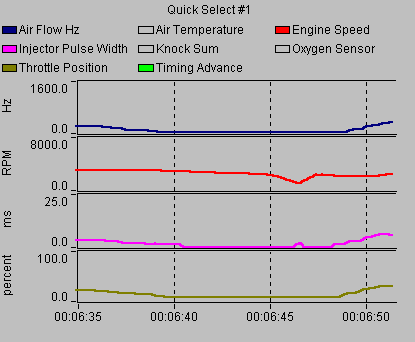 Most fuel injected engines will shut the fuel off completely when coasting.
This log file shows such a case. The RPMs are in the normal driving
range, but the throttle is closed and the injector pulse width is at zero.
At about 6:48 on this log, you can see the throttle tip in and the injector
pulse width comes up. This is what it sounds like
just as the fuel comes on. You may need headphones or good speakers
to here it, as the relevant frequencies are fairly low.
Most fuel injected engines will shut the fuel off completely when coasting.
This log file shows such a case. The RPMs are in the normal driving
range, but the throttle is closed and the injector pulse width is at zero.
At about 6:48 on this log, you can see the throttle tip in and the injector
pulse width comes up. This is what it sounds like
just as the fuel comes on. You may need headphones or good speakers
to here it, as the relevant frequencies are fairly low.
This is what that sound looks like on the spectrum analyzer.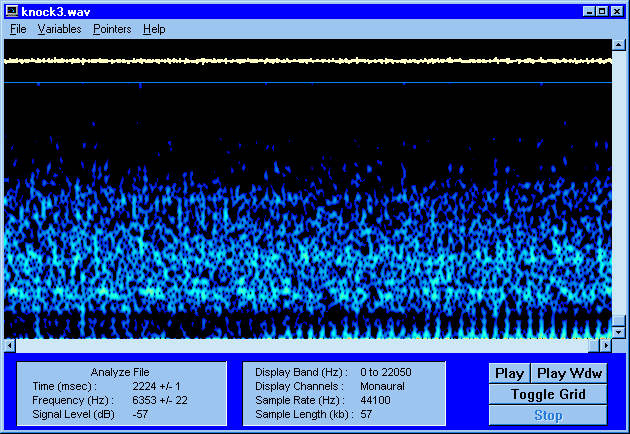
Look at the bottom half inch of the spectrum. The left half of the
image is almost empty in this region, but the right half shows strong "spikes".
Each of these spikes is a cylinder firing. You can see almost exactly
where the fuel turns on! I measured the spikes at 11.6ms apart, which
would correspond to 2586 RPM.
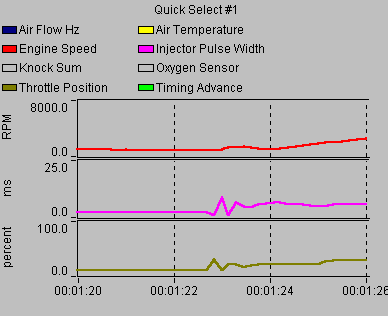
Here is an example of a gentle start from idle, and what it sounds like. The injectors normally fire (open) in sync with the engine, at 5° before TDC on the compression stroke (note 1). During accel, fuel is added simultaneously into all four cylinders every 10 ms, in addition to the sequential injection (note 2). I don't normally log accel enrichment, so unfortunately that does not show in my log. Listen to the sound (recording starts near the middle of the log above). Hear the "zzzzt" staticy sound just as the throttle first starts to tip in? Those seem to be our accel pulses!
And we can see the extra pulses in the spectrum!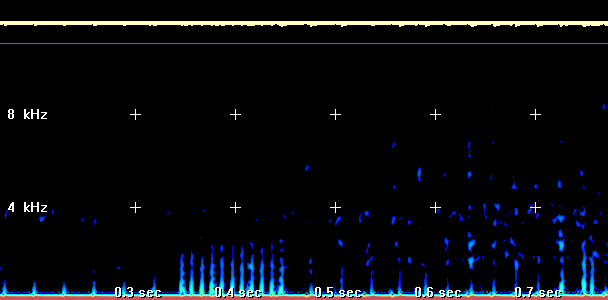
This is the portion of the sound that covers this image. This spectrum here is much cleaner than the previous examples because we are at idle, and the engine is much quieter at idle. We happen to be idling at 1000 RPM, so that means the crank rotates once every 60 ms, and a cylinder fires once every 30 ms, or roughly 3 times for each 1/10th second shown on the chart. But there is an obvious region here where there are three times as many pulses as normal, that is, once every 10 ms! Not only that, but the pulses appear to be much stronger than normal, implying that all four injectors are firing simultaneously, just like the book says they should!
Also notice that there is something going on at the end of the image (right hand side). The last three pulses look stronger than normal, and the very last pulse is only 10 ms from its neighbor. My interest in this is that it is audible! Even though it is only a few very short pulses, I can hear it in the sound file!
| Written and maintained by Bill Sundahl |
Last modified on August 23, 2002
|